Lungora was formulated for adults over 50 seeking daily respiratory support, healthy lung function, and lasting vitality. Rather than relying on a single “hero” ingredient, it’s built around a proprietary blend of six ingredients selected to support the body’s natural nerve health pathways while providing broad nutritional and antioxidant support. This page walks through each ingredient, why it was selected, and what published research says about it.
A note on how to read this page: the exact amounts formulated into Lungora are printed on the Supplement Facts panel on the product label. The research summarized below reflects what has been studied about each ingredient in the published scientific literature generally — it is not a clinical trial of Lungora as a finished product, and results from any supplement can vary from person to person. Always check the label on the bottle you receive, and talk with a doctor or pharmacist before starting any new supplement, especially if you take medication or manage a health condition.
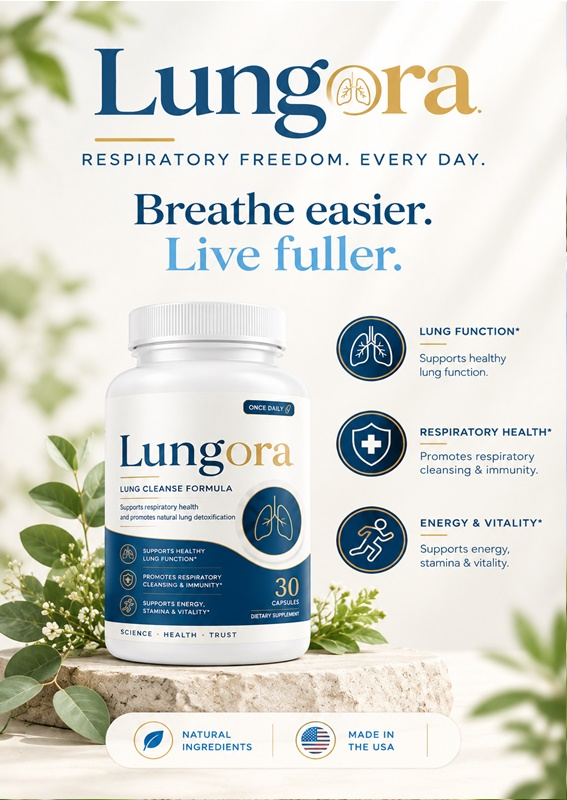
The Philosophy Behind the Blend
Rather than combining dozens of ingredients at token amounts, or relying on harsh stimulants and temporary solutions, Lungora uses six ingredients found in today’s leading lung health formulas, chosen to work together across three connected areas: nerve health support (magnesium glycinate, which plays a role in healthy nerve signaling alongside muscle relaxation), circulatory support (butcher’s broom), and nutritional and antioxidant support (alpha lipoic acid, L-carnitine, turmeric, and CoQ10). The idea behind this design is that healthy nerve function, circulation, and resilience to everyday oxidative stress all play a role in how adults over 50 experience daily energy, comfortable breathing, and long-term vitality — which is why Lungora is formulated as balanced, daily support meant to complement a long-term wellness routine rather than deliver a quick, temporary effect.
1. Magnesium Glycinate — 80mg
Magnesium glycinate is magnesium bound to the amino acid glycine, a chelated form generally associated with gentler digestion and good absorption compared with less bioavailable forms like magnesium oxide. Magnesium itself is involved in more than 300 enzymatic reactions in the body, including those related to muscle relaxation and nervous system signaling.
A 2026 randomized, double-blind, placebo-controlled trial in healthy adults with self-reported poor sleep quality specifically examined magnesium bisglycinate supplementation, with most improvements in sleep measures emerging within the first two weeks of daily use (published in Nature and Science of Sleep). Glycine itself has also been studied independently for its calming, inhibitory role in the nervous system, which is part of the rationale for pairing it with magnesium in a recovery-focused formula. Lungora includes 80mg of magnesium glycinate per serving as part of its foundational, whole-body recovery support.
2. Alpha Lipoic Acid (ALA)
Alpha lipoic acid is a naturally occurring compound that functions as a potent antioxidant, notable for being both water- and fat-soluble, which allows it to work throughout different tissue types in the body. ALA’s antioxidant activity comes from several mechanisms: it directly scavenges reactive oxygen species, helps regenerate other antioxidants like glutathione and vitamins C and E, and chelates certain metals that can otherwise drive oxidative damage.
Clinical research on ALA spans several areas, including its established use for diabetic neuropathy and its studied role in modulating oxidative stress and inflammatory markers more broadly — a 2025 mechanistic review discussed its relevance across several inflammatory conditions, including asthma, alongside cardiovascular and neurological research. In a whole-body wellness formula, ALA’s role is best understood as general antioxidant and cellular-stress support, rather than a targeted treatment for any single condition — the research base is strongest for its broader role in managing oxidative stress throughout the body.
3. Butcher’s Broom (Ruscus aculeatus) Root Extract
Butcher’s broom is a Mediterranean shrub whose rhizome has a long history of traditional use for supporting healthy circulation, particularly in the venous system. Its steroidal saponins, including ruscogenin, are the compounds most associated with its traditional use.
The strongest clinical evidence for butcher’s broom comes from studies on chronic venous insufficiency: a multi-center, double-blind, randomized, placebo-controlled trial of 166 patients found that a standardized Ruscus aculeatus extract significantly reduced leg volume and improved circulatory symptoms compared with placebo over a 12-week period (Vanscheidt et al., 2002, Arzneimittelforschung). This research base is specific to venous circulation rather than pulmonary function directly, but the underlying idea — supporting efficient blood flow so that oxygen-rich blood circulates well throughout the body — is the rationale for including it in a formula focused on whole-body vitality.
4. L-Carnitine
L-Carnitine is an amino acid derivative that the body uses to transport long-chain fatty acids across the mitochondrial membrane, where they’re broken down to produce cellular energy through beta-oxidation. Because fat is a major fuel source for sustained, everyday energy, adequate carnitine availability is considered important for maintaining metabolic flexibility and stamina.
Research published in Frontiers in Endocrinology (2024) and reviews in the sports-science literature describe L-carnitine’s role in supporting mitochondrial fatty-acid transport, reducing exercise-induced oxidative stress, and helping delay fatigue during sustained activity. A separate randomized controlled study found that L-carnitine supplementation reduced fasting-induced fatigue in patients with metabolic syndrome. As with several ingredients in this formula, evidence is strongest for its role in supporting energy metabolism generally rather than for any single, isolated outcome.
5. Turmeric (Curcuma longa) Rhizome Extract, 95% Curcuminoids
Turmeric’s primary bioactive compounds — curcumin and related curcuminoids — are among the most extensively studied plant compounds in nutritional science, with a well-documented profile of antioxidant and anti-inflammatory activity (comprehensively reviewed in Frontiers in Immunology, 2025). A standardized 95% curcuminoid extract, as used in Lungora, is intended to ensure a consistent, measurable concentration of the plant’s most active compounds per serving.
One well-known limitation of curcumin is its naturally low oral bioavailability — much of what’s ingested is metabolized quickly and poorly absorbed. A 2023 scoping review of human clinical trials found that around three-quarters of double-blind, randomized, placebo-controlled trials reported beneficial effects on clinical outcomes or biomarkers, with the largest evidence base in inflammation-related conditions such as metabolic and musculoskeletal disorders. Because of curcumin’s bioavailability challenge, formulas that include it are often paired with an absorption enhancer — worth keeping in mind if bioavailability specifically matters to you, and worth checking your label to see whether Lungora pairs it with one.
6. Coenzyme Q10 (as Ubiquinone)
Coenzyme Q10 (CoQ10) is a compound naturally produced by the body and found in every cell, where it plays a central role in the mitochondrial electron transport chain — the process that generates the majority of the body’s cellular energy (ATP) — while also functioning as a lipid-soluble antioxidant that helps protect cell membranes from oxidative damage.
CoQ10 levels naturally decline with age, which is part of the rationale for supplementation as part of an energy- and vitality-focused formula. Clinical research on CoQ10 spans cardiovascular health, where a review of clinical evidence in heart failure patients found favorable effects on cardiac energetics without adverse hemodynamic effects (published in the Journal of Clinical Medicine), as well as emerging research into post-viral fatigue and mitochondrial dysfunction more broadly. As with the other ingredients in this formula, CoQ10’s research base is strongest for general cellular energy and antioxidant support rather than for any single specific condition.
How the Six Ingredients Work Together
None of these six ingredients is marketed or studied as a treatment for a specific disease, and none of the research cited above is a clinical trial of Lungora itself. What connects them is a shared focus on supporting the body’s natural nerve health pathways, circulation, and nutritional and antioxidant status — the everyday foundations that adults over 50 often look to support as part of a routine aimed at comfortable breathing, steady energy, and lasting vitality, rather than a single isolated outcome.
If any of these ingredients could interact with a medication you take — magnesium, ALA, and CoQ10 in particular have known interactions worth discussing with a pharmacist — that conversation is worth having before you start. And if you want the precise formulation for the batch you received, the Supplement Facts panel on your bottle is always the definitive source.
Frequently Asked Questions
Are all six ingredients backed by human clinical trials? The strength of evidence varies by ingredient. Butcher’s broom and CoQ10 have more established randomized controlled trial data; L-carnitine and alpha lipoic acid have a mix of strong mechanistic and clinical evidence depending on the outcome studied; curcumin has a large but mixed body of human trials, limited mainly by its natural bioavailability; magnesium glycinate’s sleep-related research is newer and still developing.
Is Lungora’s formula designed to treat a specific condition? No. Lungora is a dietary supplement, not a drug, and none of its ingredients are intended to diagnose, treat, cure, or prevent any disease.
Can I take Lungora with medication? Several ingredients in this formula, including magnesium, alpha lipoic acid, and CoQ10, can interact with certain medications (such as blood thinners, diabetes medication, or blood pressure medication). Speak with your doctor or pharmacist before combining Lungora with any prescription medication.
References
- Magnesium Bisglycinate Supplementation in Healthy Adults Reporting Poor Sleep: A Randomized, Placebo-Controlled Trial (2026). Nature and Science of Sleep.
- Therapeutic Potential of Alpha-Lipoic Acid: Unraveling Its Role in Oxidative Stress and Inflammatory Conditions (2025). Review article, PubMed Central.
- Vanscheidt, W., Jost, V., Wolna, P., et al. (2002). Efficacy and safety of a Butcher’s broom preparation (Ruscus aculeatus L. extract) compared to placebo in patients suffering from chronic venous insufficiency. Arzneimittelforschung, 52(4), 243–250.
- Role of L-carnitine in exercise training: Anti-inflammatory, antioxidant, and metabolic interactions (2025). ScienceDirect.
- L-carnitine ameliorated fasting-induced fatigue, hunger, and metabolic abnormalities in patients with metabolic syndrome: a randomized controlled study. PubMed Central.
- Curcumin, an active component of turmeric: biological activities, nutritional aspects, immunological, bioavailability, and human health benefits — a comprehensive review (2025). Frontiers in Immunology.
- Curcumin Supplementation and Human Disease: A Scoping Review of Clinical Trials (2023). PubMed Central.
- Coenzyme Q10: A Comprehensive Review of Its Roles in Mitochondrial Health and Systemic Function (2025). SSRN / ResearchGate.
- Clinical Evidence for Q10 Coenzyme Supplementation in Heart Failure: From Energetics to Functional Improvement. Journal of Clinical Medicine, PubMed Central.
This article is for general educational purposes and reflects published research on these ingredient categories, not a clinical evaluation of Lungora as a finished product. Lungora is a dietary supplement, not a drug, and is not intended to diagnose, treat, cure, or prevent any disease. Always check the exact ingredient panel on your product label and consult a healthcare professional before starting any new supplement.